Waste heat from
Data centers
Sustainable & smart
Sustainable waste heat from data centers
Waste heat from data centers offers several advantages in terms of the environment:
Conservation of energy
Circular economy
Reduction of CO2 emissions:
- By using waste heat to heat buildings or other processes, the need for fossil fuels can be reduced.
- This leads to a reduction in CO2 emissions and contributes to climate protection.
Increase in the degree of utilization:
-
The use of waste heat from data centers leads to increased efficiency in the overall system of energy use. The redirected waste heat reduces the need for additional energy in downstream applications, such as building heating, which leads to a more efficient use of the energy used overall.
-
Increasing energy efficiency leads to lower energy consumption and therefore lower costs for data center operators.
Use of renewable energies:
- The waste heat from data centers can be upgraded/reheated using renewable energies. For example, the temperature level can be raised by using a heat pump in order to heat buildings.
- This contributes to a sustainable energy supply.
Promotion of the circular economy:
- The use of waste heat from data centers is an example of the circular economy.
- In the circular economy, resources are used, upgraded and reused as efficiently as possible, thus avoiding waste.
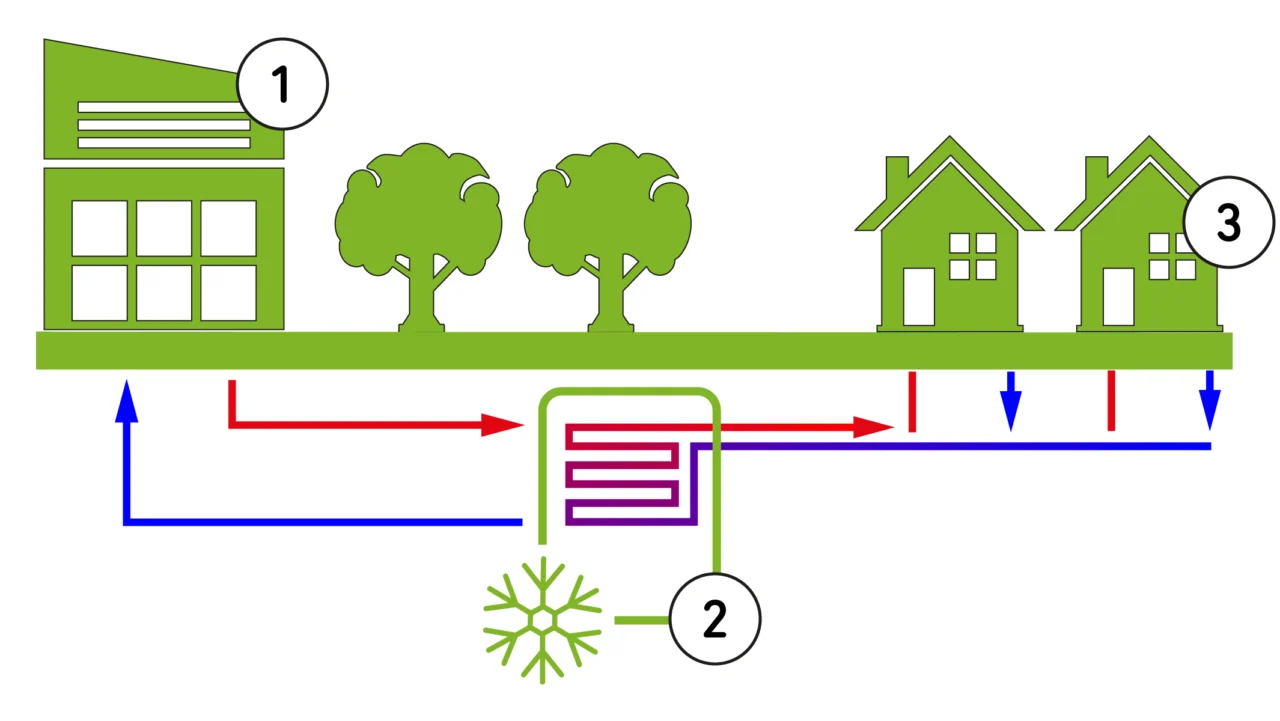
The sustainable use of waste heat from data centers
This example shows how the waste heat from a data center (1) is temporarily stored in an ice store (2). This intermediate step has the advantage that the adjoining residential quarter (3) can draw the heat and air conditioning cold when it is needed.
In summary, the use of waste heat from data centers offers several advantages in terms of the environment. The most important advantages are the reduction of CO2 emissions, the increase in energy efficiency, the use of renewable energies, the conservation of resources and the promotion of the circular economy.
However, it is important to note that the use of waste heat from data centers is also associated with challenges.
Challenges:
The use of waste heat from traditional (air-cooled) data centers is not without its challenges. For example, the waste heat usually has to be treated before it can be used for other purposes.
Concepts for using waste heat from water-cooled data centers:
By using water cooling, as is already the case in some HPC (High Performance Computing) environments, higher waste heat temperatures of over 60°C (compared to 25°C-32°C with air cooling) can be achieved, which makes it possible to feed into district heating networks.
Due to the relatively high temperature, the energy required to raise the heat pump to the required temperature level is correspondingly lower.

DataHall
The company DataHall has developed a data ecosystem concept that will be implemented as a DigitalPark in Halle (Saale, DE) from 2025 in collaboration with GETEC.
Yes, I would like the presentation from the PowerBuilding & Datacenter Convention in April 2024 in Rüschlikon (ZH).
Concepts for using waste heat from air-cooled data centers:
1. direct heat extraction from the cold water circuit:
Thermal energy is extracted from the return flow of the chiller (with temperatures between 25 and 35 °C). A heat exchanger is used to transfer the thermal energy to a separate system, e.g. a cold local heating network. This concept is particularly suitable for heating buildings in the vicinity of the data center.
2. hot water extraction from chillers:
The hot refrigerant gas is branched off upstream of the chiller's condenser. The heat energy recovered can be transferred to an external system via a heat exchanger. By reducing the load on the chiller, this concept can also improve the efficiency of refrigeration.
3. parallel connection of heat pumps:
Additional heat pumps are installed in parallel with the existing chillers. The heat pumps raise the temperature level of the waste heat, making it usable for various applications. This concept enables more flexible use of the waste heat, e.g. for district heating or industrial processes. Each of these concepts has its own advantages and disadvantages. The optimal solution depends on the specific conditions of the data center and the potential consumers of the waste heat.
Other factors that need to be considered when selecting an implementation concept:
- Temperature of the waste heat: The temperature of the waste heat determines which applications are possible.
- Availability of waste heat: The amount and availability of waste heat can vary depending on the data center operation.
- Distance to customers: The distance to potential consumers of waste heat plays a role in the economic efficiency of its use.
- Existing infrastructure: The existing infrastructure in the data center and at the customers can influence the choice of concept.
It is important to carry out a detailed analysis of the framework conditions in order to find the optimum concept for the use of waste heat from a data center.
In summary, it can be said that the use of waste heat from data centers can make a valuable contribution to the energy transition and climate protection.
Technologies for energy generation (electricity / heating / cooling)

Photovoltaics
Solar thermal energy

Heat pumps
Geothermal energy

Agrothermics

Ice storage

Hydrogen (H2)